
The exponential growth of global data consumption has placed unprecedented demands on network infrastructure. Enterprises, cloud providers, and service operators are looking for solutions that not only deliver higher bandwidth but also balance cost efficiency and scalability. While the industry is gradually moving toward the deployment of 400G Ethernet, 100G technology continues to play a vital role in meeting today’s requirements. Among the various 100G solutions, the 100GBASE-LR4 QSFP28 1310nm 10km LC Duplex SMF DDM Optical Transceiver Module remains one of the most important products, offering long-distance, high-performance connectivity while acting as a practical bridge to the 400G era.
Overview of 100GBASE-LR4 QSFP28
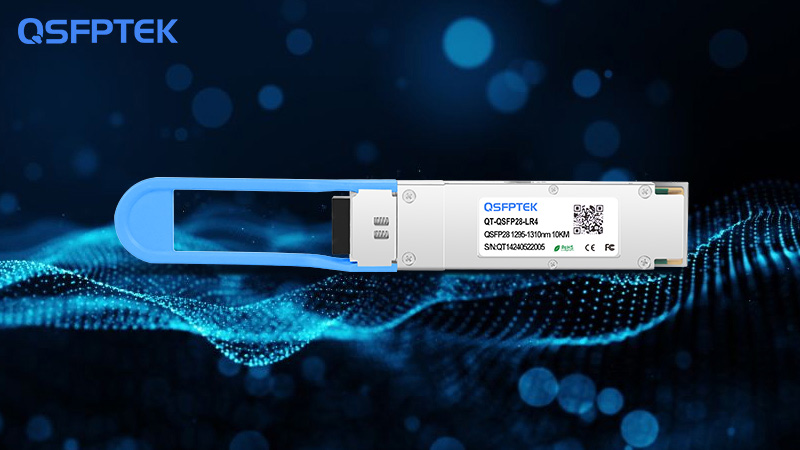
The 100GBASE-LR4 QSFP28 transceiver is designed to deliver reliable 100 Gigabit Ethernet connections over single-mode fiber. Operating in the 1310nm wavelength range, it uses wavelength division multiplexing to transmit four 25Gbps lanes, achieving an aggregate data rate of 100Gbps. With an LC duplex interface, it can reach distances of up to 10 kilometers, making it highly suitable for data center interconnects, enterprise backbones, and telecom networks. Its compact QSFP28 form factor ensures space savings and energy efficiency, while digital diagnostic monitoring (DDM) provides real-time insight into performance parameters, giving operators confidence in long-term stability and network health.
Why 100GBASE-LR4 QSFP28 Remains Essential Before 400G
Although 400G technology is steadily gaining momentum, 100GBASE-LR4 QSFP28 continues to dominate existing deployments. The maturity of the 100G ecosystem ensures stability, proven performance, and a broad base of industry experience that reduces risks during implementation. Its cost-effectiveness also makes it an attractive choice, particularly when compared with the higher investment and operational expenses associated with 400G modules. Furthermore, 100GBASE-LR4 QSFP28 offers excellent compatibility with current networking equipment, allowing organizations to smoothly upgrade from earlier generations without costly overhauls. For enterprises handling applications such as cloud migration, video traffic, and IoT expansion, 100G provides ample scalability, making it a reliable solution even in an era of rapid digital transformation.
The Transition to 400G Networks
The rise of emerging technologies, from cloud services and artificial intelligence to 5G and edge computing, has made the need for 400G Ethernet increasingly urgent. With four times the capacity of 100G, 400G promises to handle the explosive data demands of hyperscale data centers and next-generation telecom networks. Several types of 400G modules are already in use, including SR8 for short-reach multimode fiber, DR4 for 500-meter single-mode fiber, and LR4 for 10-kilometer long-haul links. Yet, despite its promise, 400G deployment faces challenges such as higher costs, increased power consumption, and ongoing standardization. These barriers mean that many organizations are not yet ready to fully embrace 400G, creating a gap that 100GBASE-LR4 QSFP28 continues to fill.
How 100GBASE-LR4 QSFP28 Bridges the Gap
In this transitional period, the 100GBASE-LR4 QSFP28 serves as an essential bridge between legacy 40G deployments and future 400G infrastructure. For businesses that do not yet require the capacity of 400G, 100GBASE-LR4 delivers sufficient bandwidth for today’s workloads at a fraction of the cost. At the same time, it allows for hybrid deployment models in which 100G and 400G modules can coexist. With the help of multiplexing technologies and breakout cabling, network operators can create flexible infrastructures that adapt to both current and future needs. Importantly, investments in 100GBASE-LR4 are not wasted; the use of single-mode fiber ensures compatibility with 400G upgrades, protecting existing infrastructure and enabling smooth scalability when the time comes to expand.
Future Outlook
Looking ahead, the 100GBASE-LR4 QSFP28 will remain an indispensable solution in global networks. For many enterprises and telecom operators, 100G provides the perfect balance between performance and affordability, and it will continue to meet demand for years to come. Small and medium-sized organizations in particular will benefit from its accessibility, while even large-scale operators will continue to rely on 100G modules in aggregation and edge scenarios alongside 400G deployments. Far from being rendered obsolete, 100G will retain its position as a cost-efficient and reliable workhorse that complements the rise of 400G technology.
Conclusion
The 100GBASE-LR4 QSFP28 1310nm 10km LC Duplex SMF DDM Optical Transceiver Module is more than just a widely used optical transceiver; it is a strategic enabler of the network evolution journey. By combining reliability, cost-effectiveness, and scalability, it ensures that networks can meet current requirements while remaining prepared for the next wave of technological advancement. As the industry progresses toward 400G, the role of 100GBASE-LR4 QSFP28 is clear: it provides the bridge between present demands and future innovation, protecting investments while enabling a smooth and efficient transition. For enterprises and service providers alike, it remains a cornerstone of high-speed networking.