
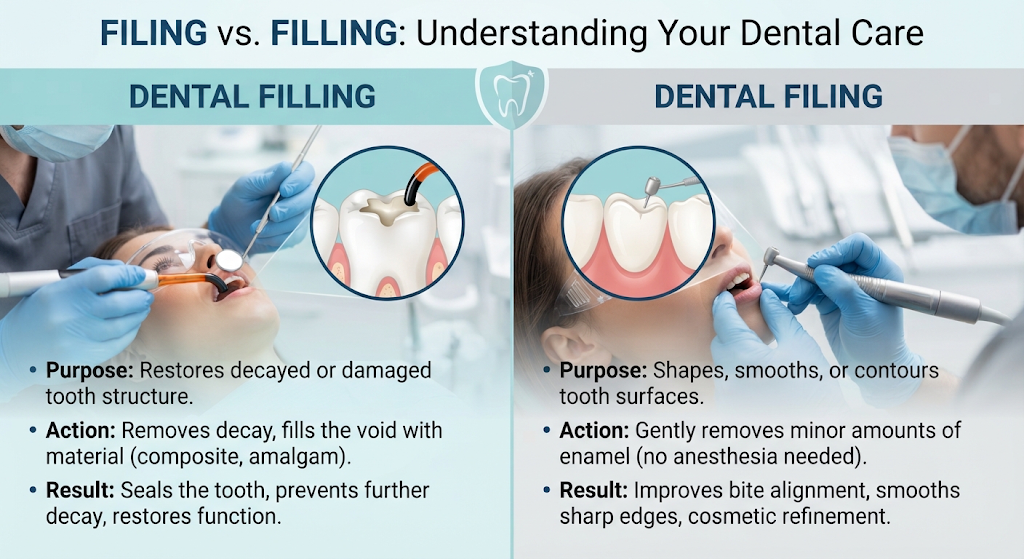
Have you ever looked at your dental bill, stared at the treatment notes, and wondered if your dentist made a typo? The confusion between filing and filling is surprisingly common. While they sound identical, they represent completely different aspects of your dental care—one handles your paperwork and insurance, while the other saves your tooth from decay.
Let’s clear up the confusion once and for all so you can speak your dentist’s language with total confidence.
What is a Dental Filling?
A dental filling is a restorative procedure used to treat a cavity or repair a cracked, fractured, or worn-down tooth. When tooth decay damages the enamel, your dentist cleans out the infected area and seals the space with a durable material.
Common Filling Materials
- Composite resin: Tooth-colored fillings that blend seamlessly with your natural smile.
- Amalgam: Silver-colored fillings known for their exceptional durability and longevity.
- Gold and Porcelain: High-end, custom-made inlays or onlays designed for ultimate strength.
What is Dental Filing?
Dental filing, on the other hand, has nothing to do with treating cavities. Instead, it refers to the mechanical shaping, smoothing, or contouring of a tooth’s surface.
Dentists typically use this technique for minor adjustments. For example, if a newly placed filling feels a bit too high or sharp against your tongue, your dentist will gently file down the excess material for a comfortable bite. It is also used in cosmetic dentistry to smooth out minor chips or uneven edges.
Key Differences at a Glance
To easily keep these two terms straight, consider this quick comparison:
| Feature | Dental Filling | Dental Filing |
| Primary Purpose | Restores a decayed or damaged tooth. | Shapes, smooths, or contours tooth surfaces. |
| Procedure Type | Medical/Restorative treatment. | Adjustive/Cosmetic refinement. |
| Common Materials | Composite, amalgam, gold, porcelain. | None (uses diamond burs or sanding strips). |
| Insurance Code | Restorative procedure codes. | Often included in adjustments or contouring. |
Frequently Asked Questions
Does dental filing hurt?
No, dental filing is completely painless. Because the outer layer of your tooth (enamel) does not contain nerve endings, smoothing or contouring it requires no anesthesia and feels similar to getting your fingernails filed.
How long do composite fillings last?
Standard composite fillings typically last between 5 to 10 years before they might need repair or replacement, depending on your oral hygiene habits and where the filling is located in your mouth.
Can insurance cover both procedures?
Yes, but under different categories. Dental fillings are generally classified as basic restorative care and are frequently covered (at least partially) by insurance. Purely cosmetic filing, however, may not be covered.
Conclusion
Understanding the difference between filing and filling helps you navigate your dental visits with ease. Whether you need a cavity sealed with a sturdy restoration or a sharp edge smoothed out for comfort, knowing the right term ensures clear communication with your dental team.
Ready to learn more about keeping your smile healthy? Check out our related guide on how to prevent cavities before your next checkup!