
Pool water chemistry can seem complicated, but one chemical plays a quiet but essential role: pool stabilizer.
Also called pool conditioner or cyanuric acid (CYA), this substance helps keep your chlorine effective for longer.
Without it, sunlight rapidly breaks down chlorine, forcing you to add more sanitizer more often.
Understanding what pool stabilizer does, when to add it, and which form to use can simplify pool maintenance and reduce costs.
What Is Pool Stabilizer and How Does It Work?
Pool stabilizer is a chemical derived from cyanuric acid.
When added to pool water, it binds loosely with free chlorine molecules.
This bond protects chlorine from the ultraviolet (UV) rays of the sun.
In an unstabilized outdoor pool, nearly half of the chlorine can disappear within a few hours of direct sunlight. By adding stabilizer, you slow that breakdown significantly.
The chlorine remains available to kill bacteria, control algae, and keep the water clear.
The active ingredient in most stabilizers is cyanuric acid, typically at 98–100% purity in dry forms, or 25–28% in liquid formulas. It is safe for all pool surfaces — vinyl, fiberglass, plaster, and painted finishes — when used according to directions.
Stabilizer does not get consumed like chlorine.
If the water level stays constant, a single application at the start of the season may be enough.
However, whenever you add fresh water — for example, after draining for winter or repairing a leak — you must replenish the stabilizer to maintain proper levels.
Most outdoor chlorine pools require a stabilizer level between 30 and 70 parts per million (ppm).
Saltwater pools often need a slightly higher range, typically 50 to 70 ppm.
Keeping the concentration within these bands helps chlorine work efficiently without over-stabilizing, which can actually reduce sanitizer effectiveness.
Types of Pool Stabilizers
- Powder stabilizer – Pure cyanuric acid in granular form. It dissolves slowly, so you must brush the pool after adding to prevent settling. Best for precise dosing.
- Liquid stabilizer – A pre-dissolved solution that mixes quickly. No brushing required if poured along the pool edge. Ideal for fast results.
- Stabilized chlorine – Chlorine tablets or granules that already contain cyanuric acid. Convenient because you add sanitizer and stabilizer together, but it makes it harder to control each chemical independently.
Choosing the right type depends on your routine. Powder gives you full control; liquid saves time; stabilized chlorine simplifies dosing for beginners.
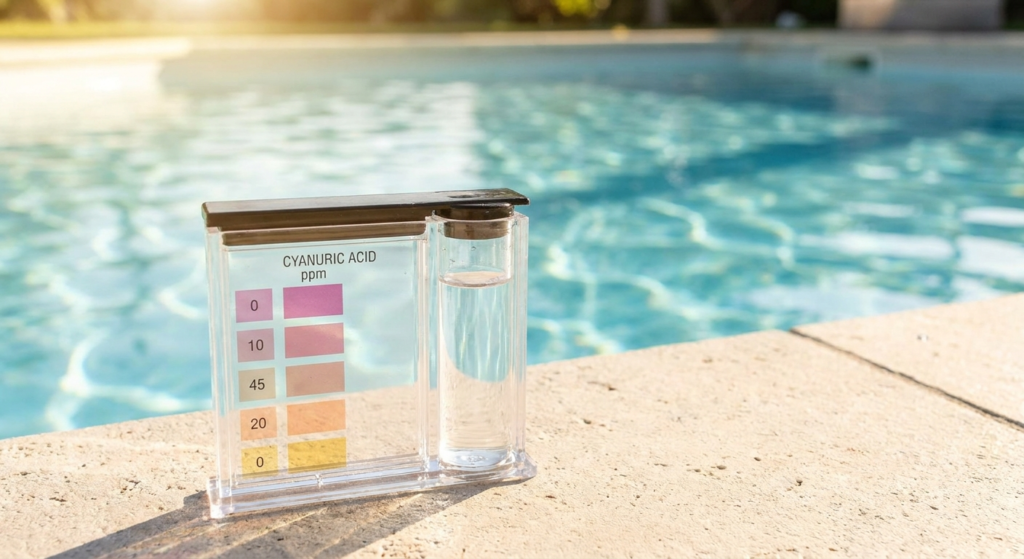
Before adding any stabilizer, always test the current cyanuric acid level using test strips or a liquid test kit. Many pool retailers offer free water testing.
If the level is already above the recommended range, adding more stabilizer can cause problems such as cloudiness and reduced chlorine activity — a condition called over-stabilization.
When the reading is below the target zone, calculate the amount needed per 10,000 gallons.
For most granular products, 1 pound raises CYA by about 30 ppm.
For liquid stabilizers, check the label carefully — one gallon typically adds around 30–35 ppm to a 10,000‑gallon pool.
When and How to Add Pool Stabilizer
The best time to add stabilizer is at the start of the swimming season, after filling the pool with fresh water. You also need to add it following any significant water replacement — for example, after heavy rain, splash-out, or backwashing that removes water.
Application Methods
- Through the skimmer – Place the required amount of granular stabilizer in a skimmer sock and put it in the skimmer basket. Run the pump continuously for 24–48 hours. This method works best when the product is labeled for skimmer use.
- Pre-dissolving – Mix granular stabilizer in a bucket of warm water (it dissolves slowly) and pour the solution around the pool perimeter. This prevents clumping and avoids cloudy water.
- Pouring liquid – Simply shake the container well and slowly pour liquid stabilizer in front of a return jet while the pump runs. Cloudiness may appear briefly but usually clears within 30 minutes.
After adding stabilizer, do not backwash or clean the filter for at least 48 hours. This allows the chemical to fully dissolve and circulate. Retest the water after 24–48 hours to confirm the level has reached the target range.
Many pool owners ask whether they can use common household ingredients as a substitute.
Baking soda, for example, is often mentioned in pool care discussions.
While baking soda can help raise total alkalinity, it is not a true alternative for cyanuric acid.
However, baking soda does have a stabilizer-like effect on chlorine by buffering pH.
If you are curious about using baking soda in your pool maintenance routine, this article explains how it works and when it can be used: pool stabilizer.
Maintaining proper stabilizer levels delivers clear benefits.
It reduces chlorine consumption by as much as 25% per season, according to pool chemical manufacturers.
Less chlorine means fewer chemical purchases and less handling of harsh substances.
It also means lower wear on pool equipment, because excessive chlorine can degrade components over time.
Benefits of Proper Stabilization
- Lowers chemical costs – With stabilizer protecting chlorine, you add less sanitizer throughout the season.
- Improves water clarity – Stable chlorine levels prevent algae blooms and keep water sparkling.
- Reduces skin and eye irritation – Consistent sanitizer levels mean fewer chloramines, the compounds responsible for red eyes and strong chlorine smell.
- Simplifies maintenance – Once stabilizer is set, you only need to adjust it when water is replaced. The rest of the season, you focus on pH and chlorine.
Common Mistakes to Avoid
Over-stabilization is the most frequent error.
If cyanuric acid exceeds 70–80 ppm, chlorine becomes less effective — a phenomenon known as “chlorine lock.” The only fix is to partially drain and refill the pool.
Always test before adding any stabilizer, and follow the dosage chart on the product label.
Using stabilizer in indoor pools is unnecessary because UV degradation does not occur indoors. Likewise, pools treated with bromine or non-chlorine shock do not require cyanuric acid.
Final Thoughts
A pool stabilizer is a simple, cost-effective tool that protects your chlorine investment.
By adding it at the right time and in the correct amount, you keep your pool water clean, clear, and comfortable all summer long.
Regular testing and occasional adjustments ensure you never waste chemicals or struggle with algae.
Whether you choose powder, liquid, or stabilized chlorine, understanding this key chemical makes pool ownership easier and more affordable.